

In This Article:
Toggle
Every election, voters are told some version of the same thing: you may dislike both major candidates, but one is worse, so you have to vote for the other.
My question is what happens when both candidates are people you genuinely believe would do a poor job. Does being slightly less bad automatically make one of them worthy of your vote? Or is there a point where the lesser-of-two-evils argument breaks down?
Independent Florida Quick Take
If you believe both major candidates are unacceptable, the fact that one is clearly better than the other does not suddenly make that candidate a good choice. The real question is where you draw the minimum line a candidate has to clear before earning your vote. If fear of the other party always overrides that standard, neither party has much incentive to offer dissatisfied voters something better.
The Lesser-of-Two-Evils Argument Has to Break Down Somewhere
Years ago, I came across a Facebook debate about the lesser of two evils that changed the way I thought about this. One person insisted that even if you disliked both major candidates, you still had to vote for whichever one was less bad. Voting for anyone else made no sense because those candidates couldn’t win.
Someone challenged that argument with an intentionally extreme scenario. Imagine the two major candidates were Adolf Hitler and Joseph Stalin, but there were eight other candidates on the ballot. Who would you vote for?
I thought the point was obvious. Surely you would vote for one of the other eight. Instead, the person said they would vote for Hitler because Stalin was worse and the other candidates had no chance of winning.
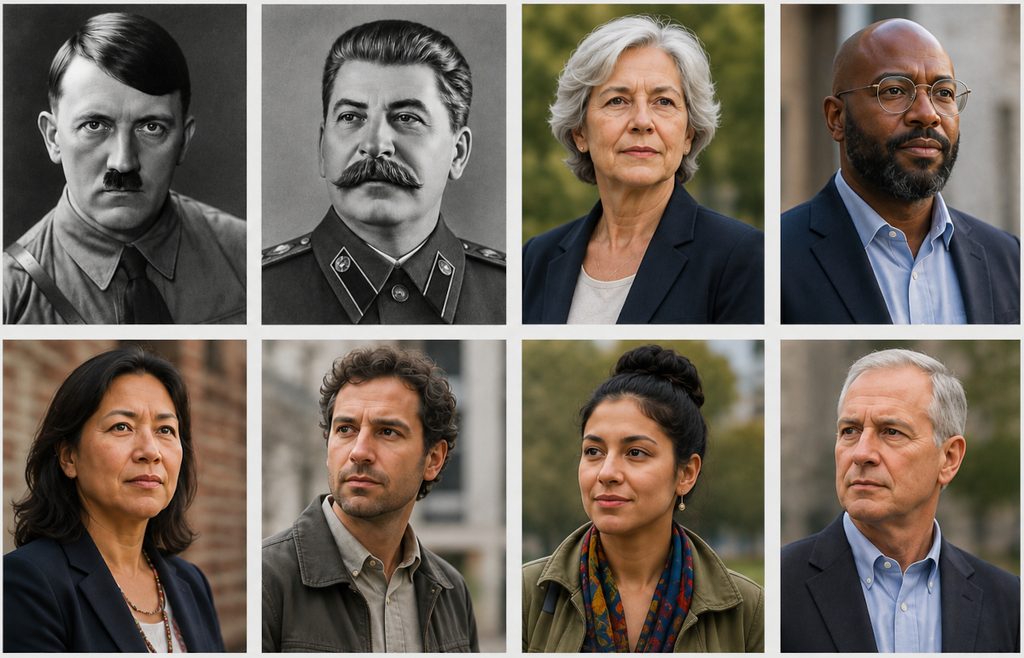
Obviously, this isn’t a comparison between Hitler or Stalin and modern American politicians. It is an extreme example meant to test the logic. If the rule is that you must always vote for the less-bad major candidate because only the two major candidates can win, then there is apparently no point where a candidate becomes too bad to deserve your vote.
I don’t buy that. At some point, being less terrible than someone else isn’t enough.
Where Is Your Line?
A simple five-point scale makes the problem easier to see. Imagine 5 is an exceptional candidate, 2.5 is roughly the minimum you consider acceptable for the job, and 0.5 is someone you believe would be terrible in office.
A THOUGHT EXPERIMENT
Which Candidate Gets Your Vote?
Imagine you’ve researched all five candidates for president.
For now, don’t worry about who can win. Who do you think would make the best president?
If the candidates are a 4 and a 3.5, there is no “lesser evil.” You think both would do a reasonably good job, so vote for the 4. Even a 3.5 versus a 1.5 isn’t really the problem I’m talking about. You have a candidate you consider good and another you consider bad. Vote for the 3.5.
But what if the two major-party candidates are a 1.0 and a 1.25, while another candidate on the ballot is someone you would rate a 3.5?
The 1.25 is better than the 1.0. I’m not pretending otherwise. But if your minimum standard is 2.5, neither one meets it. Meanwhile, someone you consider substantially better is already on your ballot.
So why does being slightly better than the other major-party candidate suddenly make the 1.25 acceptable?
Maybe your minimum isn’t 2.5. Maybe it’s 2.0, or 1.5. That’s your decision. But there has to be a point where “better than the other one” isn’t enough—or your minimum standard isn’t really a minimum at all.
How low would you go?
Because voting for a candidate is accepting that candidate as your choice. You may be doing it because you think the alternative is worse, but you’re still choosing them.
But One of Them Is Going to Win
This is the strongest practical argument for voting for the lesser evil: elections determine who actually holds power, and one of the two major candidates is likely to win. If you believe there is a meaningful difference between them, of course that difference matters.
But it doesn’t answer the question we’ve already established. If both candidates fall below the minimum standard you believe someone should meet before earning your vote, does the worse candidate make the other one acceptable? I don’t think so. Otherwise, a party can keep your vote no matter how poor its candidate becomes, as long as it convinces you the other party is worse.
What Happens When We Stop Accepting That Choice?
This is where an individual voting decision starts affecting the larger political system.
Suppose one party nominates a candidate you rate a 1 and the other nominates a 1.25. You may spend the entire election complaining about how terrible the choices are. But if you ultimately vote for the 1.25, the party still got what it needed from you.
From its perspective, being a 1.25 was enough.
That creates a terrible incentive. A party doesn’t necessarily have to find someone you would rate a 3 or 3.5. It just has to remain slightly more acceptable than the party you fear most. The other party faces the same incentive in reverse.
Now change the calculation. If enough voters are willing to say, “Neither of you cleared my minimum standard, so I’m voting for someone else,” those votes become something the major parties can no longer take for granted. They have a reason to ask why those voters left and what it would take to win them back.
There is evidence that many Americans feel caught in exactly this tension. In 2025, Gallup found that 62% of Americans believed the Republican and Democratic parties were doing such a poor job that a third major party was needed. Yet 57% were highly concerned that voting for a third-party candidate would waste their vote, and 59% worried it could help elect their least-preferred candidate. In other words, many Americans want another choice while fearing the consequences of actually choosing it. Read the 2025 Gallup research.
Voting differently doesn’t guarantee that the major parties will improve or that a third party will suddenly become competitive. Political change isn’t that predictable. But parties have far less reason to compete for dissatisfied voters who continue voting for them anyway.
And while America’s political system has generally favored two major parties, those parties have not always been Republicans and Democrats. We look at that history separately in History of U.S. Political Parties. The larger point is that today’s parties are dominant, not permanent.
Your Vote Is Yours
None of this means you should automatically vote third party. If a Republican earns your vote, vote Republican. If a Democrat earns it, vote Democratic. If an independent or third-party candidate earns it, vote for that person.
What I reject is the idea that one of two parties is automatically entitled to your vote because it managed to nominate someone slightly less objectionable than the other one.
We spend a lot of time asking why the parties keep giving us candidates we don’t want. But there’s another question worth asking: Why would they stop if we keep voting for them anyway?
If enough voters maintain a minimum standard, the incentive changes. Major parties can improve what they’re offering and win those voters back. Alternatives can gain support. And a party that repeatedly fails to earn enough votes can eventually lose its place as one of the dominant choices.
The objective isn’t necessarily to destroy the two-party system. It’s to make the parties replaceable. A party that knows it can lose your vote has a reason to earn it.
If you’re wondering what voting for a candidate who probably won’t win actually accomplishes, that’s the question we tackle in Why Vote Third Party?. And if the alternative you’re considering is simply staying home, read Not Voting: Is This a Good Option?.
The next time someone tells you that you have to vote for the lesser of two evils, ask yourself a different question. Not just which candidate is worse, but whether either candidate has actually met the minimum standard you believe someone should meet before you give them your support.
Where is your line?
 | Reviewed & Approved by Greg Martin Greg is a longtime Florida voter registered with no party affiliation who has been questioning America's political choices since the 2008 election. He created Independent Florida to examine political choices from a voter's perspective, challenge conventional assumptions about voting and party loyalty, and explore ideas that could give voters better options. |
Last Reviewed: September 2026