

In This Article:
Toggle
When you think about how government should work, what do you picture?
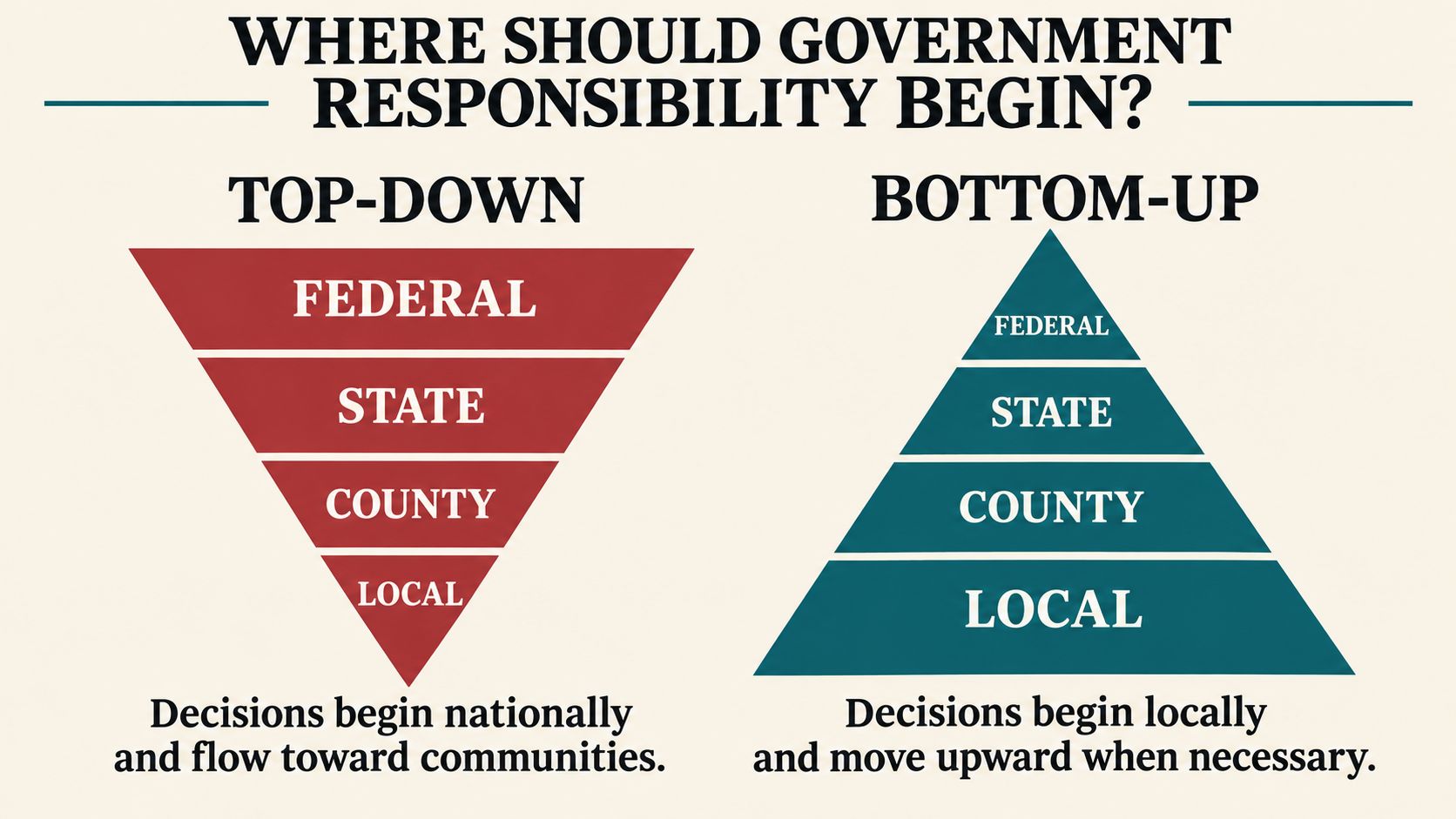
Do you see Washington as the starting point, with policies and solutions flowing down through the different levels of government until they reach your community?
Or do you picture government working from the bottom up, with decisions beginning close to home and responsibility moving to higher levels only when necessary?
You may not have given much thought to that distinction. But how you view the structure of government can influence your position on almost every political issue.
And it may explain why you sometimes find yourself disagreeing with someone who wants many of the same things you do.
Independent Florida Quick Take
- Top-down government: Emphasizes national standards, coordination, and shared resources to address problems across the country.
- Bottom-up government: Emphasizes local knowledge, flexibility, accountability, and moving responsibility to higher levels when necessary.
- Both approaches have tradeoffs: National programs can provide consistency but may add bureaucracy. Local solutions can better reflect community needs but may lack resources or coordination.
- The central question: Which level of government is best equipped, and constitutionally authorized, to handle a particular responsibility?
Two Ways of Looking at Government
The United States has federal, state, county, and local governments. Each has responsibilities, but people disagree about how those responsibilities should be divided. Political scientists call the division of authority between national and state governments federalism. But knowing that term doesn’t necessarily tell us where responsibility should begin or how much authority each level should exercise.
Someone with a top-down perspective generally looks to Washington to establish national priorities, standards, and programs. State and local governments may then implement those policies, adapting them where appropriate. Someone with a bottom-up perspective begins closer to home. If a community can solve a problem effectively, it should generally have the opportunity to do so. Responsibility moves upward when the problem requires greater resources, authority, or coordination.
That bottom-up principle is sometimes called subsidiarity: handling a responsibility at the lowest level capable of managing it effectively. Neither perspective requires every decision to be made at one particular level. The difference is where each begins when considering a problem.
The Case for Top-Down Government
There are good reasons to believe some responsibilities are better handled nationally. Consider a business operating across 30 states. Having to comply with 30 substantially different sets of rules can be expensive and complicated. National standards can simplify operations while providing consistent protections for workers and consumers.
National programs can also help communities that lack the resources to address important needs on their own. Federal funding allows resources to be shared across the country rather than making every community depend entirely on its own tax base. Someone who favors this approach may be particularly concerned about people falling through the cracks because of where they live or the resources available in their communities.
Supporters of top-down government often emphasize four advantages:
- Consistency: National standards can establish protections and expectations that don’t change dramatically at state borders.
- Shared resources: Federal funding can help communities that lack the financial capacity to provide essential services.
- Coordination: Problems involving multiple states may require national leadership or cooperation.
- Broad protections: Federal authority can help protect people when state or local governments fail to respect their rights or address serious problems.
The Constitution also grants the federal government powers that individual states cannot exercise in the same way. Congress has authority over interstate commerce, for example, and the Fourteenth Amendment gives Congress power to enforce its protections against state violations. Federal authority isn’t necessarily an expansion beyond the constitutional design. In important areas, it’s part of that design.
Consider a river that runs through several states or pollution that drifts across state lines. Those problems can be difficult for any one state to manage alone, particularly when actions in one state affect people in another. National coordination can provide a common framework and a way to resolve competing interests.
The advantage of top-down government is its ability to establish broad protections, coordinate across boundaries, and share resources. The challenge is ensuring that national policies remain responsive to the different circumstances of the people they serve.
The Case for Bottom-Up Government
Now consider a farmer in rural Kansas and an actor living in Los Angeles. They live in the same country, but their economic circumstances, costs of living, and community needs may be dramatically different.
Take the minimum wage. Federal law sets a floor of $7.25 an hour, and Kansas uses that rate. Other states have established higher minimum wages, and some local governments have adopted their own rates. The U.S. Department of Labor tracks the different state requirements.
The current system combines a federal minimum with state variation, although some states restrict cities and counties from setting their own rates. Should Washington establish the minimum, should states decide, or should local communities have more authority to reflect their own economic conditions? Someone favoring bottom-up government might argue that state and local governments are better positioned to understand their communities and develop policies that fit their circumstances.
That reflects one of the strongest arguments for this approach: the people closest to a problem often have the best understanding of what is actually needed. Local decision-making can also offer other advantages.
Accountability and administrative efficiency. When decisions are made locally, residents may have greater access to the officials responsible. As responsibility moves through several levels of government, it can become harder to determine who should be held accountable when something goes wrong. A federal program implemented through state and local agencies may also require multiple layers of administration, compliance, and reporting. Those layers cost money, and their benefits should justify that expense.
Flexibility and experimentation. Communities can adapt policies to their circumstances rather than working within a single set of detailed national requirements. States and communities can also try different solutions, compare results, and learn from one another. Successful approaches can spread without requiring every state to follow the same policy from the beginning.
Fifty States, Fifty Opportunities to Learn
Suppose 49 states have found effective ways to educate their students, but one state continues to struggle. Does that mean we have a national problem requiring a new federal solution? Or could the struggling state learn from what the other 49 are doing successfully?
It can examine their approaches, adapt promising ideas, and work with other states to improve its results. The successful states don’t have to abandon their approaches, and Washington doesn’t necessarily need to create another national program. Good ideas can spread through cooperation and demonstrated success rather than national mandates.
In his 1932 dissent in New State Ice Co. v. Liebmann, Justice Louis Brandeis described how a state could serve as a laboratory for experimenting with new policies without imposing those experiments on the entire country. The concept became known as the laboratories of democracy.
There’s a difference between a government that cannot solve a problem and one that hasn’t yet found an effective solution. Before transferring responsibility upward, it’s worth asking whether the problem genuinely requires higher-level authority or whether existing governments can solve it by learning from one another.
The Constitutional Question
For many supporters of bottom-up government, this is also a question of constitutional authority. The Constitution delegates powers to the federal government, including enumerated powers and those constitutionally implied by them. The Tenth Amendment reserves powers not delegated to the federal government, or prohibited to the states, to the states or the people.
People disagree about how broadly certain federal powers should be interpreted. But the underlying principle matters: Washington doesn’t have unlimited authority simply because it believes it can develop a better solution. Even if a federal policy might work, does the federal government have the constitutional authority to impose it?
Different Needs, Shared Rights
The farmer in Kansas and the actor in Los Angeles may benefit from different economic policies. But should they have different constitutional rights? Of course not. Freedom of speech and protection against compelled self-incrimination apply throughout the country because the Supreme Court has held that the Fourteenth Amendment makes those protections enforceable against state governments as well.
This process is called incorporation, and federal courts have an important role in enforcing those protections when states violate them. National defense and problems that genuinely cross state boundaries are other examples of responsibilities that may require federal authority. Someone who generally favors bottom-up government can recognize those responsibilities without abandoning the principle of local decision-making.
Likewise, someone who favors top-down government can recognize that national responsibility doesn’t always require identical policies. The minimum wage already works this way in part: Washington sets a floor, and states can establish higher requirements, with local authority depending on state law.
The question isn’t whether national consistency or local flexibility is always better. It’s which responsibilities require each, and how they can work together.
How Our Priorities Shape Our Perspective
The differences between these philosophies aren’t limited to questions of efficiency or constitutional authority. They can also reflect what people are most concerned about when government makes mistakes. Consider a program designed to help people who are struggling to afford food. Most people would agree that assistance should reach those who genuinely need it while minimizing waste and abuse, but designing a program to accomplish both can be difficult.
Conservatives often place greater emphasis on controlling costs, preventing improper assistance, and maintaining accountability. Taken too far, strict requirements can prevent eligible people from receiving help. Liberals often place greater emphasis on ensuring that people in need receive assistance. Taken too far, an emphasis on access can result in excessive waste or insufficient oversight.
Both concerns are legitimate. Government should be trying to accomplish both objectives, not treating one as an acceptable sacrifice for the other. The difficulty is designing programs that balance those priorities effectively.
These priorities can also influence preferences about where decisions belong. Someone focused on accountability may favor local organizations that can evaluate individual circumstances and tailor assistance to actual needs. Someone focused on ensuring broad access may favor national standards and funding so that assistance doesn’t depend entirely on a community’s resources or priorities.
These tendencies aren’t absolute. A person can support national funding with local administration, or local programs with generous eligibility requirements. But recognizing the concerns behind each approach helps explain why people may disagree about the structure of government even when they share the same goals.
Understanding the Difference Changes the Conversation
Imagine discussing education with someone who believes Washington should establish stronger national standards. You might argue that states and local communities should be responsible for improving their schools. They might argue that children deserve reasonable educational opportunities regardless of where they live. You may both want better schools, but disagree about which level of government should be responsible for achieving that goal.
Once you recognize that difference, the conversation becomes more useful. Instead of repeatedly defending competing policies, you can ask why someone believes a problem requires federal involvement, what lower levels of government can accomplish, and what evidence would justify moving responsibility elsewhere.
You can also consider the risks each person is trying to avoid. One may be concerned about unequal outcomes and people being left behind. The other may be concerned about unnecessary bureaucracy, poor accountability, and policies that don’t reflect local needs. Understanding those concerns doesn’t mean you have to agree with the other person’s solution, but it allows you to evaluate the reasoning behind it rather than assuming disagreement reflects ignorance or bad intentions.
Which Pyramid Do You See?
Do you generally believe government responsibility should begin with national standards and coordination, or with the people and governments closest to the problem?
Your answer may depend on the issue. Constitutional rights, interstate problems, local economic conditions, and community services don’t necessarily require the same approach. Understanding your own assumptions, and those of someone who disagrees with you, can change the conversation. You may discover that you agree about what needs to be accomplished but disagree about who should be responsible.
Before arguing about what action government should take, perhaps we should ask which government should act.
 | Reviewed & Approved by Greg Martin Greg is a longtime Florida voter registered with no party affiliation who has been questioning America's political choices since the 2008 election. He created Independent Florida to examine political choices from a voter's perspective, challenge conventional assumptions about voting and party loyalty, and explore ideas that could give voters better options. |
Last Reviewed: November 2026