


In This Article:
Toggle
You know how most political arguments go.
You make your point. The other person gives the same response everyone’s heard a million times. You give the expected answer to that, and now you’re in the normal script that everyone has already memorized—just play the tape. Sound familiar?
Sometimes, if you want a real conversation, you need to stop following the script. Sometimes you need to flank the argument.
Independent Florida Quick Take
Instead of attacking someone’s political position from the direction they expect, try getting to the other side of it. Take their argument farther than they do, make them explain why they stopped where they did, and develop the arguments they use to pull you back.
Then slide those arguments back toward the real disagreement and ask why the same considerations do—or don’t—apply there. You may discover a principle you can both work with, a distinction that actually matters, or that the real disagreement is very different from the one you thought you were having.

What Does It Mean to Flank an Argument?
Most political arguments are fought head-on.
If someone is arguing from the left, you attack from the right. If they’re arguing from the right, you attack from the left. That’s usually where they’re expecting you, and they’ve probably defended that side of their position plenty of times before.
Flanking means going around them instead. If they’re to your left, go farther left. If they’re to your right, go farther right. Get to the other side of their position and argue back.
But don’t stand on your side pointing toward some ridiculous conclusion and asking whether they realize where their logic leads.
Go there first.
Take the principle more seriously than they seem willing to take it. Stand on their other side and be genuinely shocked that they stopped at such a weak, compromised version of the position they were just defending. Then make them explain why.
If they give you a reason, don’t immediately jump back to your real position and announce that you’ve caught them. Stay on the flank. Challenge the reason. Make them develop it. You’re looking for the arguments they use to justify where they stopped—arguments that may also matter when you return to your actual position on the issue you really wanted to discuss.
Once those arguments are developed, you can start sliding the conversation back down the scale toward the realistic disagreement. Do the same principles apply there? If not, why not? Now you may have something worth talking about.
There is one important catch: this works much better before you’ve shown your hand.
If you’ve already spent ten minutes making the normal argument against their position, suddenly jumping to the other side is going to sound like sarcasm. They’ll see the maneuver instead of engaging with the argument.
The flank works best before you’ve revealed your actual position.
A Conservative Example: Student-Loan Forgiveness
Suppose you hear someone talking about the burden of student-loan debt and why borrowers need relief.
The standard conservative responses are sitting right there. They borrowed the money. They agreed to repay it. There were cheaper schools. Why should everyone else pay for their choices?
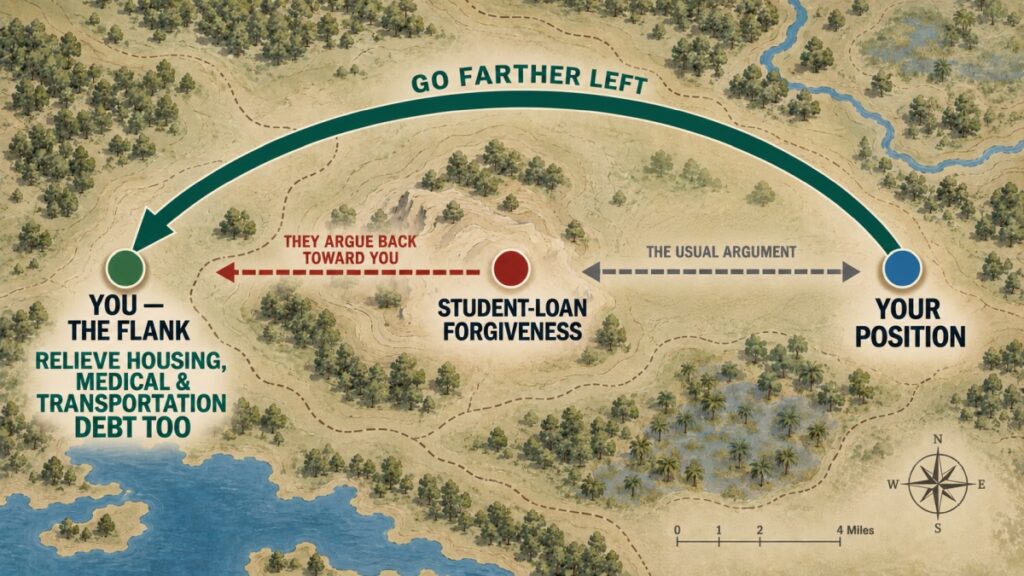
Leave those arguments alone.
Go left.
I understand why you’re concerned about student loans. But I haven’t heard you say anything about the debt crisis facing the millions of families struggling with housing, transportation and medical debt. Do you realize the impact that’s having on these families?
In the face of all that, how can you remain silent?
Notice what just happened.
You’re not the cold-hearted conservative telling struggling borrowers to pay their bills. You’re standing on the other side of the student-loan advocate, shocked that their concern for people crushed by debt apparently stops with college loans.
What about the family barely keeping a roof over their children’s heads because the mortgage is eating them alive? What about the worker who needs reliable transportation to get to work every morning? Medical debt can come from getting sick through no meaningful choice at all.
Why aren’t they getting the same concern?
Now the student-loan advocate has to come toward you.
But somebody chose to buy that house.
Don’t leave the flank. Maybe they have three children. Maybe they needed the space. Maybe they bought in that neighborhood because they wanted decent schools for their kids.
Who are you to decide what kind of home their family needed?
Maybe the response changes.
They could have bought a cheaper house.
That’s different. Now we’re talking about alternatives, so keep going. Why should a struggling family be told they should have settled for a smaller house or a different neighborhood? Why should someone else get to decide what was reasonable for them?
Maybe transportation comes up.
Nobody forced them to finance an expensive car. They could have bought something cheaper.
Again, stay there.
They needed reliable transportation. Maybe they have children. Maybe they commute fifty miles a day. Why should you decide what kind of vehicle they needed?
Keep making them develop the argument.
Eventually, you may start hearing about choices. Cheaper alternatives. How much debt someone voluntarily took on. The difference between needing transportation and needing that particular vehicle. The responsibility that comes with signing a contract and borrowing money.
Interesting. Now start sliding back. Does any of that apply to education?
There is a difference between needing an education and needing to attend a particular school. Community colleges exist. Less expensive universities exist. Different educational and career paths exist.
Maybe those weren’t reasonable alternatives in a particular case. Maybe there are important differences between student debt and a mortgage or car loan. Personally, I think student loans should generally be dischargeable through bankruptcy like other debt, rather than facing the special discharge standard they do today.
But now we can actually talk about the distinctions.
The student-loan advocate has introduced choice, alternatives, the amount borrowed and personal responsibility into a conversation that might otherwise have been framed as compassion versus indifference.
You didn’t force those considerations into the conversation.
They needed them to argue back from the flank.
Now you can find out why those considerations should—or shouldn’t—apply to student loans. That’s a much more interesting conversation than playing the tape.
A Liberal Example: Gun Rights
The same technique works in the other direction.
Suppose you’re talking with someone who treats almost any restriction on guns as an infringement of the Second Amendment. Maybe you’ve just heard the familiar:
Shall not be infringed.

Don’t start making the standard argument for gun control.
Go right.
You’re absolutely right. And frankly, I can’t believe gun-rights advocates have allowed all these age restrictions to stand for as long as they have.
Can you believe a middle schooler can’t even walk into a gun store and buy a machine gun?
It’s outrageous. The NRA and gun-rights advocates will keep taking donations, but I don’t hear them fighting for these rights.
You’re not asking whether their principle logically permits middle schoolers to buy machine guns.
You’re appalled that they aren’t already fighting for it. That’s the flank. And there’s a good chance they’re going to come after you.
Come on. A middle schooler shouldn’t be able to buy a machine gun.
Why not? If owning a gun is a constitutional right, why does the government get to decide someone is too young to exercise it?
Maybe they say children aren’t mature enough. Okay. Why does maturity matter?
Maybe they say a child can’t be trusted to handle a machine gun safely. Now safety matters. Stay on the flank. Lots of constitutional rights belong to people who might exercise them irresponsibly. Why does the possibility of someone using a firearm dangerously give the government authority to restrict access beforehand?
Make them work through it.
Maybe they’ll distinguish children from adults. Maybe they’ll talk about maturity, judgment, responsibility, danger to other people or the ability to understand the consequences of possessing a weapon.
Whatever principle they use, let them develop it. Then start sliding back toward the real discussion.
If safety can sometimes matter, when does it matter? If the danger someone poses to other people can justify a restriction in one circumstance, why can’t it justify one in another? If age is a legitimate line, what makes that restriction legitimate while another proposed restriction isn’t?
They may have perfectly good answers. That’s the point.
You haven’t proved that a particular gun-control proposal is constitutional, wise or effective. You haven’t even proved that the restriction you favor follows from the principle they just articulated.
What you’ve done is move beyond “shall not be infringed” as the entire conversation. You’ve established that some infringement is justified, and now you’re talking about why one restriction is acceptable and another isn’t.
That’s a real disagreement.
Don’t Cash Out Too Early
There can be a satisfying moment when someone finally makes the argument you’ve been waiting for. Resist the temptation to pounce on it.
If the student-loan advocate says people should have considered cheaper houses, don’t immediately say, “Exactly! They could have chosen a cheaper college too.”
If the gun-rights advocate says middle schoolers lack the maturity to safely possess machine guns, don’t immediately say, “Aha! So you admit gun restrictions are okay.”
You’ve just turned a potentially useful conversation into a gotcha. Worse, you’ve stopped the other person from developing the argument you actually need.
Stay out there a little longer.
Why should someone have chosen the cheaper house? How much responsibility should people bear for financial decisions made years earlier? Does it matter whether reasonable alternatives were actually available?
Why should maturity matter to firearm ownership? Is the concern about the person themselves, the danger to other people, or something else? What makes that restriction legitimate?
Develop the argument before you bring it back.
The better you understand the reason they’re using to restrain the more extreme version of their own position, the more useful that reason becomes when you slide the conversation back toward reality.
And maybe you’ll discover that the reason doesn’t apply to the original issue. That’s useful too.
The point isn’t to trick someone into agreeing with you. It’s to get beyond the prepared defenses and find out what principles actually survive when the position gets harder.
What If They Follow You All the Way?
Sometimes you get all the way around the position and discover that the other person is perfectly happy to meet you there.
You argue that relieving student debt isn’t enough. We should help people with mortgages, car loans, medical debt—maybe all debt.
And they say:
Absolutely. Forgive all of it.
Well, okay – maybe they mean it. In that case, student-loan forgiveness probably isn’t the conversation you need to be having.
Your real disagreement may be about the morality of debt itself. What obligations should come with borrowing money? What obligations do lenders have? When should someone be able to escape debt they can’t repay? What should bankruptcy look like? When do lending terms become exploitative? How much responsibility belongs to the borrower, the lender or society?
That’s a very different conversation.
And the flank helped you find it.
But there’s another possibility. Sometimes people seem willing to follow an argument almost anywhere because backing away would mean compromising the position they started with.
I’ve actually had that happen with the machine-gun example. I pushed the gun-rights argument out to five-year-olds having access to machine guns, expecting that at some point the person I was talking with would tell me I’d gone too far and that obviously some restrictions apply.
He didn’t. He told me five-year-olds should have access to machine guns. Maybe he genuinely believed that. I can’t know what was happening in his head.
My impression at the time was that saying otherwise would have required him to give up the absolute position of “shall not be infringed” that he had already committed himself to, and he wasn’t willing to do that.
At that point, I didn’t see much reason to keep spending mental and emotional energy on the conversation.
That doesn’t mean there could never be a worthwhile conversation with that person. Someone who isn’t willing to reconsider something today may have a different experience tomorrow. Six months from now, life may have given them a reason to think about the issue differently.
The same is true of us.
If someone flanks one of our arguments and we find ourselves defending increasingly ridiculous implications simply because we refuse to give up an inch of political ground, that’s worth noticing.
A real political conversation requires at least some willingness to think about where our own principles lead—and whether the distinctions we’re making actually hold up.
Sometimes a flank gets you there. Sometimes it reveals that the disagreement you thought you were having wasn’t the real disagreement at all.
And sometimes the smartest conversational move is recognizing that thinking isn’t what’s happening right now.
That doesn’t mean never.
As we’ve discussed in You Don’t Have to Change Someone’s Mind, political ideas sometimes need time before they go anywhere.
Sometimes right now just isn’t the time to plant the seed.
 | Reviewed & Approved by Greg Martin Greg is a longtime Florida voter registered with no party affiliation who has been questioning America's political choices since the 2008 election. He created Independent Florida to examine political choices from a voter's perspective, challenge conventional assumptions about voting and party loyalty, and explore ideas that could give voters better options. |
Last Reviewed: September 2026